
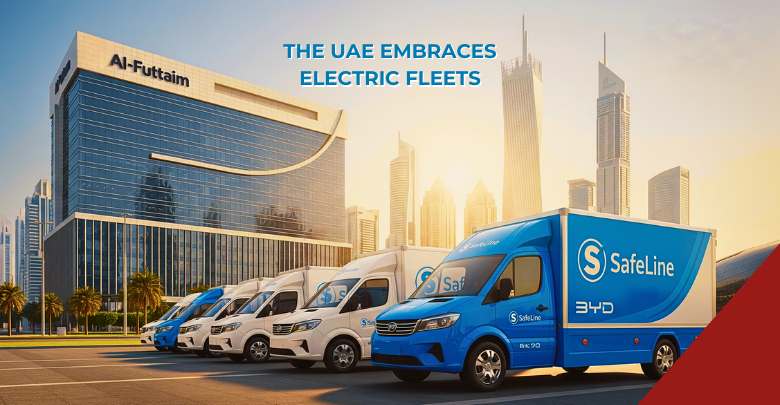
The UAE logistics industry is undergoing a transformation revolution with top distribution players moving into electric mobility to help the country reach its Net Zero 2050 goals.
Safeline Group, one of the region’s leading electrical and mechanical distribution companies with commercial presence in the UAE, has signed a strategic Memorandum of Understanding with global electric vehicle manufacturer BYD. Al-Futtaim Electric Mobility brokered this historic step for the electrification of the UAE commercial fleet.
The action is a complement to Safeline’s earlier ventures into sustainability programs, including the use of battery-powered forklifts in warehouse operations, demonstrating a general strategy for creating a green logistics infrastructure. The deal establishes the Safeline Group’s decision to buy twelve BYD all-electric commercial vehicles for a 3-year fleet replacement strategy. It signals the company’s intention to phase out internal combustion engines and completely adopt environmentally friendly transportation solutions.
Dr. Aboobacker Kuttikol, the Managing Director of Safeline Group, emphasised the strategic significance of the tie-up by affirming that it not only symbolises the modernisation of the fleet but also the company’s strong faith in sustainability and innovation. The Managing Director mentioned the company’s vision to spread the electric mobility revolution to its entire operating fleet, as well as future evaluations of electric potential for commercial vehicles to have complete incorporation of green transport.
Mohammad Kassem, Director of Franchise at BYD Al-Futtaim, explained that the partnership is a testament to Al-Futtaim Electric Mobility’s vision to create a strong electrified mobility ecosystem in the UAE. Kassem, who has spent over 15 years working in the automotive space in the Middle East and has been instrumental in BYD’s success and growth narrative in the region, stressed the importance of the alliance in helping businesses with innovative electric vehicle solutions to realise their sustainability goals.
The strategic alliance in the UAE electric vehicle market will set a record for growth. This is along with the existing EV penetration at approximately 3% of all vehicle sales and projected 30% electrification in 2030. The logistics market offers favourable avenues for electrification, with fixed routes facilitating the effective use of charging infrastructure and resulting in significant cost savings through reduced fuel dependence.
BYD UAE commercial vehicle operations have grown exponentially after the company launched four electric commercial vehicles in February 2025, namely the ETM6 electric truck, T5 light-duty truck, ETH8 medium-duty truck, and B12 electric bus, all of which are powered by cutting-edge Blade Battery technology. The commercial vehicle sales of the company have seen spectacular growth worldwide, with 763% year-over-year increases in January 2025, making BYD an industry leading player in commercial electric vehicles.
The collaboration also supports the UAE’s wide-ranging policy framework to accelerate electric mobility, such as the National Electric Vehicles Policy announced in August 2023, which seeks to harmonise charging stations and encourage private investment in EV charging station establishment. The government has ambitious plans to achieve 50% adoption of electric and hybrid vehicles by 2050, in addition to infrastructure development objectives, such as 10,000 EV charging stations by 2030.
Dubai’s Green Mobility Strategy 2030 officially aims for 10% of all cars and 30% of the government fleet cars to be hybrid or electric by 2030, with an estimated 42,000 electric vehicles on Dubai’s roads by the same time frame. The EV Green Charger Project of Dubai Electricity and Water Authority aims to have 1,000 charging stations by 2025. This will provide critical infrastructural support to electric commercial fleets.
The economic benefits of fleet electrification go beyond the green imperative, with logistics organisations enjoying considerable cost savings by way of cheaper electricity in comparison to diesel fuel, reduced maintenance needs, and insulation against the risk of global oil price volatility. The UAE’s strategic geographical location as a leading global trade and logistics centre further highlights the importance of commercial fleet electrification in the attainment of local carbon emissions targets. One of the best examples of business leadership in moving towards zero-emission vehicles is the UAE Climate Action Alliance Road 2.0 initiative, which the Ministry of Energy and Infrastructure has endorsed. The initiative involves the 17 signatory companies’ pledge to put 20,000 zero-emission vehicles within commercial fleets by 2040. The spirit of cooperation fostered by the initiative also spurs organisations like Safeline Group to develop their electrification plans and support national sustainability goals.
To read more on Energy News, head to the 🔗 link.
Source: Zawya