CXMT becomes China’s most valuable listed company after a record-breaking Asian IPO driven by the global AI boom.
ChangXin Memory Technologies shattered records with a 500% stock surge, becoming China’s most valuable listed company amid the global AI race.
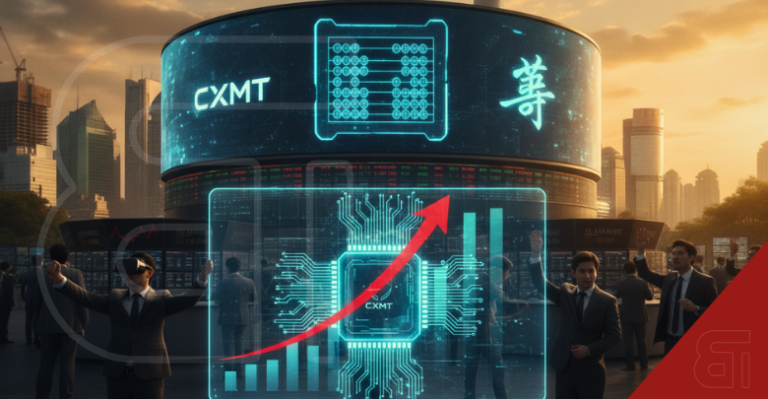
ChangXin Memory Technologies recently achieved a record-breaking market debut. The Chinese chipmaker raised 57.92 billion yuan ($8.6 billion). Consequently, this marks the largest Asian initial public offering this year. The stock price surged remarkably upon opening.
It launched at 49.50 yuan compared to an 8.66 yuan issue price. Therefore, the company’s market capitalisation soared to 3.65 trillion yuan ($539.21 billion). This tremendous growth allowed the semiconductor giant to overtake the Industrial and Commercial Bank of China.
Thus, it is now the most valuable listed company in the country. The firm primarily manufactures dynamic random-access memory chips. These components provide crucial temporary storage for smartphones, computers, and servers. Furthermore, they remain essential for operating complex artificial intelligence systems.
Samsung Electronics, SK Hynix, and Micron Technology have historically dominated this sector. However, the newly listed enterprise currently ranks as the fourth-largest global producer. Records indicate it secured a 7.7% worldwide market share in 2025.
Rising global demand for artificial intelligence applications has heavily benefited the manufacturer. Consequently, memory chip prices and sector investments have increased significantly recently. First-quarter revenue skyrocketed by 719% year-on-year to reach 50.8 billion yuan ($7.51 billion).
Moreover, executives expect first-half revenues to approach 120 billion yuan. This figure almost doubles the total earnings recorded throughout 2025. Investors clearly show immense enthusiasm for this domestic technological champion.
The dramatic stock surge highlights a strong desire to back domestic pure-play semiconductor firms. This blockbuster listing serves as a crucial gauge of current market appetite. Meanwhile, global technology stocks continue fluctuating between growth and defensive strategies.
High-speed memory remains indispensable for training modern artificial intelligence models. Therefore, the firm plays a vital strategic role for Beijing. It actively helps reduce national dependence on imported semiconductor technologies. The government has pursued this specific objective for several years.
Furthermore, recent United States export restrictions have accelerated these domestic efforts. Analysts view this market entry as a critical test of global competitiveness. State-backed investors held a 36.29% stake prior to the public offering.
These entities include local government funds and the flagship national semiconductor investment vehicle. Founder Zhu Yiming drove the initial establishment and rapid expansion of the manufacturer. He brought vital industry experience before assuming the chairman position.
Nevertheless, the firm still lags behind international rivals in advanced technologies. High-bandwidth memory chips remain firmly under South Korean control. Samsung and SK Hynix maintain their dominance through decades of manufacturing expertise.
Conversely, the Chinese challenger relies upon robust government support and state funding. Increasing domestic demand provides another significant competitive advantage. These factors could facilitate steady market share expansion over time.
However, stringent United States export controls present substantial operational challenges. Restricted access to advanced manufacturing equipment complicates technological advancement. Geopolitical uncertainties continue creating additional hurdles for the expanding enterprise.
The United States recently labelled the manufacturer a military-linked entity. Furthermore, regulatory committees previously approved its inclusion on a restrictive trade list. Despite these risks, executives plan to deploy the raised capital strategically.
They will expand manufacturing capacity, enhance production technology, and increase research investments.
(Source: The Times of India)
Read more on Global Ties News by heading to the 🔗 link.